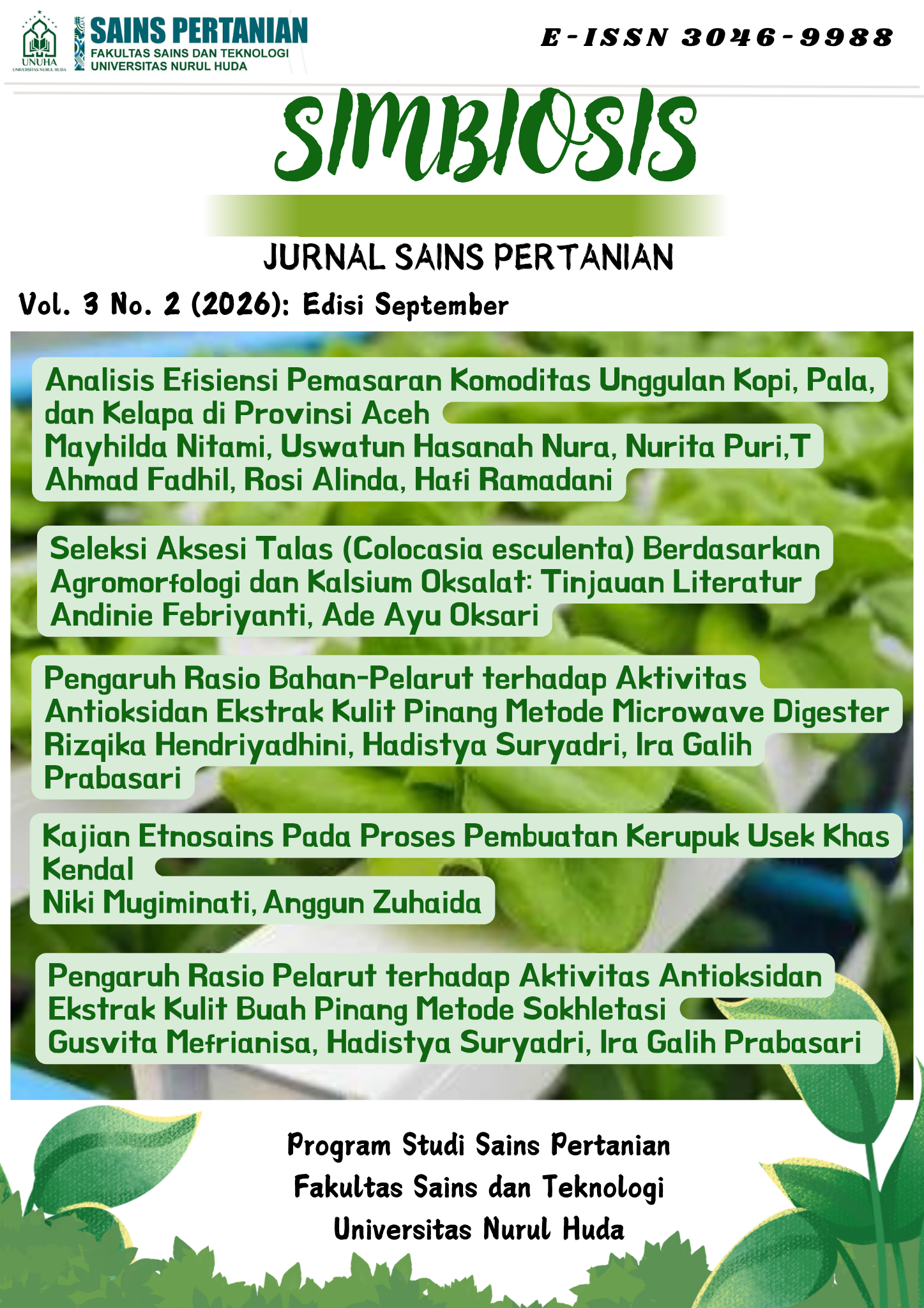
Seleksi Aksesi Talas (Colocasia esculenta) Berdasarkan Agromorfologi dan Kalsium Oksalat: Tinjauan Literatur
DOI:
https://doi.org/10.30599/yzvkjm95Keywords:
Aksesi Talas, Agromorfologi, Colocasia Esculenta, Kalsium Oksalat, Keamanan PanganAbstract
Talas (Colocasia esculenta) merupakan tanaman pangan lokal yang berpotensi sebagai sumber
karbohidrat alternatif. Namun, pemanfaatannya sebagai bahan pangan masih terbatas akibat keberadaan
kristal kalsium oksalat yang dapat menyebabkan rasa gatal dan menurunkan tingkat penerimaan
konsumen. Kandungan kalsium oksalat pada talas diketahui bervariasi antar aksesi dan dipengaruhi oleh
faktor genetik serta kondisi lingkungan tumbuh. Meskipun penelitian mengenai keragaman karakter
agromorfologi dan profil kalsium oksalat telah banyak dilakukan, kajian yang mengintegrasikan kedua
aspek tersebut sebagai dasar seleksi aksesi talas rendah oksalat masih terbatas. Artikel ini bertujuan
untuk mengulas variasi karakter agromorfologi, profil kalsium oksalat, serta potensi integrasi kedua
parameter tersebut dalam seleksi aksesi talas yang lebih aman untuk dikonsumsi. Kajian literatur
dilakukan dengan menelaah artikel ilmiah yang diperoleh dari basis data Google Scholar, Scopus, dan
ScienceDirect pada rentang publikasi tahun 2015–2025. Hasil kajian menunjukkan bahwa karakter
agromorfologi memiliki tingkat keragaman yang tinggi antaraksesi, sedangkan kandungan kalsium
oksalat dipengaruhi oleh faktor genetik dan lingkungan sehingga tidak dapat dijelaskan hanya
berdasarkan karakter morfologi. Oleh karena itu, karakter agromorfologi dapat digunakan sebagai tahap
awal dalam karakterisasi aksesi, sedangkan evaluasi kandungan kalsium oksalat diperlukan untuk
mendukung penentuan aksesi yang lebih aman sebagai bahan pangan. Kajian ini menunjukkan bahwa
penggunaan kedua parameter secara terpadu memberikan dasar yang lebih baik dalam proses
identifikasi dan seleksi aksesi talas dibandingkan apabila masing-masing parameter digunakan secara
terpisah.
References
Amalia, N., Rugayah, & Tjitrosoepomo, G. (2014). Keragaman bentuk dan distribusi kristal kalsium oksalat pada beberapa anggota famili Araceae. Jurnal Biologi Indonesia, 10(2), 267–276.
Andarini, Y. N., & Risliawati, A. (2018). Variabilitas karakter morfologi plasma nutfah talas (Colocasia esculenta) lokal Pulau Jawa (Morphological Character Variability of Javanese Local Taro [Colocasia esculenta] Germplasm). Buletin Plasma Nutfah, 24(1), 63–76. https://doi.org/10.21082/blpn.v24n1.2018.p63-76.
Brandão, N. A., Tagliapietra, B. L., & Clerici, M. T. P. S. (2023). Taro [Colocasia esculenta (L.) Schott]: A critical review of its nutritional value and potential for food application. Food Science and Technology, 43, e00118. https://doi.org/10.5327/fst.00118.
Eco, K. C., & Belonias, B. S. (2017). Biomineralization of calcium oxalate crystals in leaves of Colocasia esculenta (L.) Schott (Araceae) in response to herbivory and water regime. Annals of Tropical Research, 39(1), 54–69. https://doi.org/10.32945/atr3914.2017.
Hang, D. T., Than Thi, T. T., Tuấn, L. M., & Savage, G. P. (2017). Effect of processing on the oxalate and calcium concentrations of two local dishes, Cơm Hến and Canh Chua Bạc Hà, prepared from taro stems. Food and Nutrition Sciences, 8(6), 624–632. https://doi.org/10.4236/fns.2017.86044.
Indrastuti, Y. E., Susana, S., Iskandar, D., & Wardana, T. Y. (2021). Kadar oksalat dan karakteristik fisikokimia tepung umbi talas (Colocasia esculenta) akibat fermentasi alami. Agrointek: Jurnal Teknologi Industri Pertanian, 15(1), 277–285.
Kaushal, P., Kumar, V., & Sharma, H. K. (2015). Comparative study of physicochemical, functional, antinutritional and pasting properties of taro (Colocasia esculenta), rice (Oryza sativa), and water chestnut (Trapa natans) flours. Journal of Food Science and Technology, 52(5), 2833–2843. https://doi.org/10.1007/s13197-014-1377-y.
Kusjayanti, T. T. (2025). Karakter agromorfologi tanaman, densitas kristal, dan kandungan kalsium oksalat umbi talas (Colocasia esculenta) dari berbagai aksesi di Kota dan Kabupaten Magelang. Journal of Agrotechnology and Science (JAS). https://jom.untidar.ac.id/index.php/jas/article/view/4496.
Minantyorini dan I. Hanarida somantri, panduan karakterisasi dan evaluasi plasma nutfah talas, Bogor; komisi nasional plasma nutfah, Dapartemen pertanian, 2002. ISBN 979-8393-02-3.
Mabhaudhi, T., Chibarabada, T. P., Chimonyo, V. G. P., Murugani, V. G., Pereira, L. M., Sobratee, N., Govender, L., Slotow, R., & Modi, A. T. (2019). Mainstreaming underutilized indigenous and traditional crops into food systems: A South African perspective. Sustainability, 11(1), 172. https://doi.org/10.3390/su11010172.
Maretta, D., Sobir, Helianti, I., Purwono, & Santosa, E. (2020). Genetic diversity in eddoe taro (Colocasia esculenta var. antiquorum) from Indonesia based on morphological and nutritional characteristics. Biodiversitas, 21(8), 3525–3533. https://doi.org/10.13057/biodiv/d210814.
Mohd Zulkhairi, A., Razali, M., Umikalsum, M. B., Mohd Norfaizal, G., Aimi Athirah, A., & Siti Aisyah, M. N. (2020). Determination of oxalates in corms of selected taro (Colocasia esculenta) varieties in Malaysia using ultra high-performance liquid chromatography. Asian Journal of Chemical Sciences, 7(3), 28–37.
Mulyaningsih, E. S., Anggraheni, Y. G. D., & Sulistyowati, Y. (2019). Genetic diversity in taro (Colocasia esculenta L. Schott) germplasm procured from seven provinces of Indonesia. SABRAO Journal of Breeding and Genetics, 51(3), 295–310.
Nigussie, M. (2025). Nutritional & anti-nutritional quality of taro (Colocasia esculenta): A review. Innovation, 6(1), 8–14. https://doi.org/10.11648/j.innov.20250601.12.
Paopun, Y., Thanomchat, P., & Kronburee, N. (2024). Calcium oxalate crystals in leaf and petiole of wild taro (Colocasia esculenta (L.) Schott) using light microscopy, scanning electron microscopy and energy dispersive X-ray spectroscopy. Microscopy and Microanalysis Research, 37(1), 1–12. https://ph02.tci-thaijo.org/index.php/mmres/article/view/251482
Pitoyo, A., Prameta, A. A., Marsusi, M., Suratman, & Suranto. (2018). Morphological, anatomical and isozyme variability among taro (Colocasia esculenta) accessions from southeastern part of Central Java, Indonesia. Biodiversitas, 19(5), 1811–1819. https://doi.org/10.13057/biodiv/d190531.
Saleh, S. (2019). Reducing the soluble oxalate and phytic acid in taro corm chips by soaking in calcium salt solutions. Alexandria Journal of Food Science and Technology, 16(2), 9–16.
Sari, L. I., Wardoyo, E. R. P., & Ifadatin, S. (2023). The relationship of taro (Colocasia esculenta (L.) Schott) in Kubu Raya Regency, West Kalimantan based on morphological characters. Buletin Kebun Raya, 26(3), 140–147. https://doi.org/10.55981/bkr.2023.2408.
Talang, H., et al. (2025). Assessment of nutritional quality of taro (Colocasia esculenta) genotypes and their potential as food resources. Foods. https://pmc.ncbi.nlm.nih.gov/articles/PMC12014443/
Vulla, K. E., & Mmanda, F. P. (2025). Optimizing oxalate reduction in taro leaves (Colocasia esculenta (L.) through soaking and drying techniques for inclusion in a farmed fish feed. European Journal of Nutrition & Food Safety, 17(5).
Zi, H., Chen, R., Jia, N., & Ma, Y. (2024). Impact of cooking duration on calcium oxalate needle-like crystals in plants: A case study of vegetable taro flowers in Yunnan. Foods, 13(23), 3730. https://doi.org/10.3390/foods13233730.
Downloads
Published
Issue
Section
License
Copyright (c) 2026 Andinie Febriyanti, Ade Ayu Oksari

This work is licensed under a Creative Commons Attribution 4.0 International License.